Measured by NuaSense weather stations and soil probes on Kenyan farms, over the period stated with each figure. Past readings, not a forecast.
Tuesday's reading
At the agrovet counter, this question comes in two forms. A grower holds a pocket anemometer and asks if that will do. Or they are pricing a portable weather station, the tripod-and-logger type, and asking whether a fixed mast on a post is worth the trouble. Both questions assume the instrument is what you are buying. It is not. You are buying a record. Where the instrument stands and how often it looks decide what that record is.
A handheld reading is a visit. A portable station on a tripod is a longer visit, a day or a week, then it goes back in the pickup. A fixed mast is a residence. It sits through the night, the fog and the dust, and keeps counting whether anyone remembers it or not. The FAO annex on the integrity of weather data says it plainly: estimates of reference evapotranspiration are no better than the weather data they rest on. A record built from Tuesday afternoons is a record of Tuesday afternoons.
What a handheld can honestly record over one season
Treat the handheld seriously. It is the cheapest instrument in this article, and it does real work. A pocket anemometer answers one question well: is it too windy to spray right now. A pocket thermometer with humidity answers another: is the air dry enough that the spray will flash off before it lands. The person holding the device takes those decisions at the moment of the reading. For that job, a handheld is close to ideal. The number is fresh, and the location is exactly where the sprayer is.
Trouble starts when that same grower wants to look back. A season of handheld readings is a column of visits with gaps between them. The gaps are not random. Nobody walks out at two in the morning to take a humidity reading, and that is when leaves wet up and disease gets a foothold. Nobody records the gust that flattened the shade net before dawn. The file leans toward daylight, dry weather and days when the grower had time.
There is a second limit. A handheld has no fixed height and no fixed exposure. One day it is read at waist height beside the sprayer. The next it is by the gate, and the next in the lee of the store. The FAO annex notes that wind accuracy depends on the upwind fetch as much as on the instrument, and a handheld has a different fetch every time. So the season's file cannot be compared with itself. A handheld belongs in the sprayer's pocket. A grower who buys one hoping it will also serve as the farm's weather record will be disappointed by the second job without noticing, because the first job will go fine.
Only a mast that stays put can count the hours
Most of the values a farm wants are not measured at all. They are computed from a continuous series. Leaf wetness duration is a count of hours. A spray window is a score built hour by hour from wind, humidity and temperature together. Reference evapotranspiration is an equation fed every hour. A visit cannot produce any of these, because each one needs the hours in between.
Our own network shows what that looks like. Across 14 NuaSense weather stations in Kenya over 2 October 2026 to 1 November 2026, 27 percent of station-hours were recorded as leaf-wet. That works out to about 6.4 hours in an average day. Over the same period and stations, only 22 percent of 7,204 station-hours scored 60 or better on our hourly spray quality index, and 55 percent scored below 30. Those are aggregated figures across private farms, not a regional claim, and they describe a past month, not the coming one. Now look at what they imply for the handheld user: the good spray hours were a minority of the day, and the wet hours clustered where nobody was looking.
Rain is the sharpest example. Over the same month, 550 of 22,603 ten-minute readings across the network recorded any rain at all. That is 2.4 percent. Rain on a Kenyan block is a short event in a long dry file. A portable station deployed for a week catches whatever fell that week. A fixed tipping-bucket gauge catches all of it, reporting millimetres against the per-tip volume the gauge is calibrated to. Station totals for that month ranged from 0.0 mm to 118.4 mm across 12 stations that are nowhere near each other. That spread between separate farms is why a borrowed record from down the road is not yours.
A continuous mast is costly in attention, not in money. You need a post, a clear patch of ground, and the will to leave it alone. The earlier piece on how much clear ground each sensor needs laid out the exposure rules. This one only repeats the consequence. Move a mast to a tidier spot halfway through the year and you have two records, not one.
Svalbard, and why the site is the real question
The most useful study in this bank came from no farm at all, and from no warm place. A field campaign reported in the AGRIS record on wind channelling around Longyearbyen set portable weather stations in two valleys on Svalbard, alongside the official automatic station at the airport, from 1 March to 11 April 2018. Temperature and precipitation matched between the valleys. Wind did not. In the smaller valley, Longyeardalen, using only the airport record overestimated wind speed by 3 m/s on average, and wind directions at the two sites showed no correlation. The author puts this down to two different circulations: one valley driven by southeasterly winds from the synoptic flow, the other by southerly winds from a thermal circulation off two glaciers at its head.
None of the glacier detail transfers to Kenya. The mechanism does. A valley, a ridge, a line of eucalyptus, a lake edge or an escarpment makes its own airflow, and the nearest official station may sit in a different one. The Svalbard study also notes that the local forecast suffered because its source data came from an airport station at the mouth of a wider valley. That is a polite way of saying the reference site did not represent where people lived.
So it is not really portable against fixed. The real question is which site the record describes. A portable station is the right tool for finding that out. Put it on the block for a stated period, read it against whatever reference you have, and see whether the two move together. Where they do, a borrowed record may serve. Where they split, as wind did on Svalbard, the block needs its own instrument, and it needs to stay there. Portable for the survey, fixed for the record. That is the position this article takes.
The Svalbard work also teaches something by omission. Wind transport clearly altered snow depth there, yet no correlation turned up because the snow data were too coarse. A survey only proves what it can resolve. If the portable kit reads every five minutes and the reference reads hourly, or if the two sit at different heights, the disagreement may be sampling, not weather. Write down the interval and the height before the first reading. Otherwise the comparison tells you nothing you can act on.
Mounting height
Two sources here disagree on how high the anemometer should sit, and that disagreement is a buying decision. The FAO annex sets a height of not less than 2 m, and often 5 m, following WMO recommendations for agricultural stations. The US National Weather Service siting notes for personal weather stations put the ideal at 32.8 feet, which is 10 metres. A wind record at 2 m and one at 10 m are both honest. They are not the same number.
The height your mast settles on decides whether your series can ever be laid beside anyone else's. The Kenya Meteorological Department's hydrometeorology service runs through a network of seventeen automatic weather stations and two rain gauging stations, and publishes a State of the Climate report, with the 2022 edition listed. Those counts say nothing about how far any farm sits from a station. What they establish is a reference grid, and reconciliation is the right attitude to it. A tripod almost always sits at the lower end, because a tripod is what fits in a vehicle. Fine for a survey, fine for a spray decision. Not fine if the record is later expected to feed an ET0 figure that assumes a stated measurement height.
The radiation shield is the cheapest upgrade in the whole argument
The temperature sensor is a thermistor or a diode, and the University of Arizona notes on choosing and siting weather equipment describe the thermistor plainly: the voltage drop across it changes with temperature, and a logger reads the voltage. Cheap, and well understood. What separates a hobby record from a defensible one is the housing around it.
The FAO annex says temperature sensors sit in naturally ventilated radiation shields, and now and then those shields are artificially aspirated with a small fan to cut bias from heat loading by the sun. Put a sensor in still air inside a plastic louvre on a bright afternoon and it warms above the air it is meant to measure. The reading looks confident. It is just too high. Humidity is then worked out against that too-high temperature, which pushes reported humidity down. Put both into an ET0 equation and the error does not cancel. It compounds, in one direction.
Here the FAO rule that no data are better than bad data stops being a slogan. The annex warns that biased or non-representative weather data can lead to decisions that cause more economic and hydrologic harm than reasonable estimates or textbook values would. A grower who schedules irrigation from an unshielded thermometer is worse off than one working from a published monthly figure. The bad series carries the authority of looking local. The Aston University intercomparison of citizen weather stations tested popular hobby models against Met Office standard equipment in the UK. It found common instrumental biases with identifiable dependencies. It does not say hobby stations are useless, and it does not say they are fine. It says their errors have a shape. If a portable kit on offer has the sensor in a bare housing, ask what a proper shield costs. That one line decides whether you will still trust the record by the second month.
Four ways to spend the money
The bank gives two prices and nothing else. This comparison is therefore honest about where the figures stop. No source here gives a purchase price for a professional fixed-mast automatic weather station, and this article will not invent one.
- Handheld meter. Records a reading at the moment of a visit, at whatever height and exposure the hand provides. Season's record: a column of visits, daylight-biased. Cost: no figure in the sources; treat it as the cheapest line. Buys a sound decision about spraying right now. Does not buy leaf wetness hours, ET0 or a rain total.
- Portable station on a tripod, deployed for days or weeks. Records a continuous series for a stated period at a low mounting height. Cost: no vendor figure in the sources. Buys a site survey, as on Svalbard. Does not buy the night-time hours after it is packed away.
- Open-source build on the IWMI pattern. Records rainfall, temperature and wind speed every five minutes, on solar power, to a microSD card with SMS alerts. Cost: 350 US dollars each by IWMI's account, with a stated life of up to ten years. Buys a fixed, autonomous record of three variables. Does not buy humidity or sunlight, so no ET0 or leaf wetness without adding sensors.
- Fixed commercial mast. Records the full set, continuously, at a chosen height. For our own kit, a NuaSense weather station costs KES 30,000 excluding taxes, is solar powered, reaches the internet over a Safaricom SIM at about one US dollar a month or over Wi-Fi for nothing, and reports air temperature, humidity, pressure, sunlight, rainfall, wind speed, gusts and direction roughly every ten minutes, from which hourly ET0, dew point, VPD, leaf wetness duration and a spray window score are computed. Who should not buy one: a grower whose only weather decision is whether to spray this afternoon, and a grower who cannot leave a post standing in one place for a season.
Read the four rows as a ladder of record quality, not a ladder of price. The two do not line up neatly. The IWMI build and the commercial mast are both fixed and both autonomous. What differs is the variable list, and that list decides whether a spray window or an ET0 figure can be computed from the file at all. The earlier post on what a farm weather station costs in Kenya set out the cost side in more detail.
Build or buy at 350 dollars
The IWMI page on its mobile weather stations is the only source here that puts a price on a fixed autonomous station. The stations are assembled locally from off-the-shelf parts and open-source Arduino software. They measure rainfall, temperature and wind speed every five minutes and store to microSD. They send SMS alerts and run on solar, and are said to last up to ten years. The download includes build instructions, source code, an installation manual and a maintenance manual. Users can add sensors and reprogram it.
That turns a purchase into a build-or-buy question. An agrovet could answer it as a business: a shop with a technician who can solder and follow a manual could assemble and site stations for growers and sell the installation rather than the box. The 350 dollar figure is IWMI's cost in its own context. It says nothing about Kenyan parts pricing or import costs.
The payback claim needs more care. IWMI estimates the stations pay for themselves in two and a half years. The basis is their potential to reduce flood damage, in work funded by the World Bank and the Global Facility for Disaster Risk Reduction among others. That is a disaster-risk calculation. It cannot be borrowed to justify a station bought for planting dates or spray timing. The losses avoided are different losses with different sizes. The IWMI figure proves a fixed station can be cheap and long-lived. It does not prove yours will pay.
The Kenyan mini station is missing the two variables that cost money
A 2023 IEEE paper held in the Kenya National Research Fund repository describes an IoT mini weather station. It carries sensors for humidity, temperature, light intensity and atmospheric pressure, and transmits to a cloud server. The authors frame it as a data collector that feeds machine learning models for forecasting and advisory systems. They ground this in the observation that most Kenyan farmers work small plots and struggle to get timely, accurate weather information. The station does not forecast on its own.
Take the variable list and hold it up against what the farm actually decides. A spray window turns on wind, humidity and temperature. The mini station gives you two of the three, and there is no anemometer. A planting date needs a rain record above all else — the NuaSense piece on when to plant in Kenya works through that season by season and zone by zone — and rain is the one thing this design does not measure. None of that makes the design poor. It means a buyer should read the variable list before the price. Put a station out there with no rain gauge and no anemometer and you are recording how comfortable the atmosphere feels while missing the storm that washes your spray off the leaf and the wind that carries it to the neighbour.
When to buy nothing
Plenty of growers reading this should buy neither a portable weather station nor a mast. Suppose the only weather call on the farm is whether to spray this afternoon. Then a handheld anemometer and a look at the sky will do, and the money you save buys nozzles. Suppose the only call is when to re-sow after an emergence failure. A standard gauge read every morning gives you a rain total that is defensible and comparable. The earlier piece on rain gauges argued that drift is the strongest case for the cheap gauge, and that case stands.
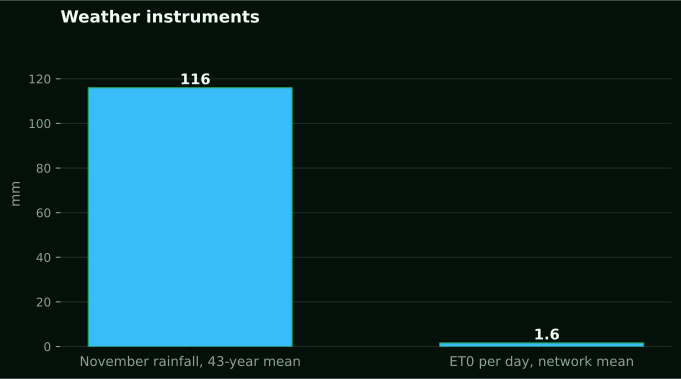
On a rain-fed farm, one crop, one planting window, the long-term record for the grid cell may serve you better than anything on a post. At the sites where our own stations stand, the CHIRPS satellite-and-gauge product gives a November average of 116 mm across the 43 years from 1983 to 2025. Driest November in that run was 47 mm in 1983; wettest was 294 mm in 2019. That is a modelled grid value, not a gauge in your field, and it describes the past rather than the season ahead. But it answers the planting-window question without a single screw.
The case for a fixed station starts where a decision turns on hours instead of days: irrigation scheduled from ET0, fungicide timing from leaf wetness, a greenhouse vent run from VPD. Across October to November our 14 stations averaged a reference ET0 of 1.6 mm per day, computed hourly with FAO-56, and a mean VPD of 0.90 kPa with a peak of 4.78 kPa. Those derived values exist only because a mast stood still for a month. Take no decision at that resolution and you are paying for a resolution you will not use. A US Department of Homeland Security note on portable weather stations for emergency responders puts the portable case in its purest form: a station carried to the incident lets responders run a hazard analysis for that place at that hour. A farm is not an incident. It is the same place every day, and the question comes down to whether the grower will let one instrument stand there and keep counting. Buy the record you will read, not the record you could.