Measured by NuaSense weather stations and soil probes on Kenyan farms, over the period stated with each figure. Past readings, not a forecast.
Two instruments, two different questions
You will find a rain sensor and a rain gauge in the same catalogue, and often they get bought for the same reason. Nobody wants to irrigate a field that has just been rained on, and nobody wants to plant on a shower that never reached the seed. But they are not the same instrument, and the catalogue seldom tells you so. University of Florida IFAS guidance on rain sensors and gauges calls the rain sensor a rain shut-off device: a cheap switch on an automatic irrigation system that spots when recent rain has already supplied plenty of water and irrigation is not needed. It says wet or dry. A gauge catches rain through a funnel and reports an amount. The better ones report it in steps of one-hundredth of an inch, from 0.01 to 99.99 inches, on that same page. One instrument closes a valve. One writes a number down.
That difference is what decides the purchase. If your block runs on a timer and a solenoid, a switch will do, because the only decision wired to it is yes or no: run the cycle or skip it. But suppose you are deciding whether the rains have put enough water into a seedbed to carry maize through emergence, or whether yesterday's storm washed a fungicide off the leaf. Wet or dry tells you nothing there. Those calls need a figure, and this piece works through which Kenyan farm decisions sit on which side of that line.
A rain sensor is a switch with a set point
A rain sensor is a threshold device fitted to an automatic irrigation controller. Florida law requires one on every new automatic irrigation system, and some counties extend that to existing sprinkler systems. Derby in Kansas goes further and publishes a rain sensor requirement that the sensor be set to turn the system off once half an inch or more of rain has fallen. Look at what that requirement actually is: a set point, not a reading. Nothing anywhere reports that 0.6 inches fell. It trips at the point its owner chose and holds the controller off until it dries out again.
That shapes how you check it. Florida's test has no display to read, because there is none. It uses three to five small containers, tuna cans in the original, spread out to catch an average half inch of rain. Set the sensor at half an inch, then try to switch the irrigation on by hand. A working sensor keeps the system off. If the system runs, the page says to check whether the sensor needs cleaning or repositioning, look for loose wires, and in some cases replace it. In that test the containers are doing the measuring; the sensor is only passing or failing against them.
Moving this to Kenya is simple on the mechanism and awkward on the law. None of the sources shows a Kenyan requirement to fit a rain sensor, and nothing here should be read as one. And on a hand-valved block with a diesel pump there is no controller to wire it to. That rules the device out for a large share of growers before cost even comes up.
What a gauge reports, and in what steps
A catching gauge collects rain through a funnel and measures what it caught. A Special Issue on rain sensors reviewed in PMC sorts instruments into catching types, which measure total amount and intensity through a funnel, and newer non-catching sensors that work rainfall out from microphysical features such as drop size distribution and fall velocity. Florida's page lists three catching mechanisms. A tipping bucket sends water into a seesaw container; after a pre-set amount the lever tips, dumps the water and sends an electrical signal that gets recorded. A weighing gauge records intense rain fairly accurately and can measure rain, hail and snow, but costs more and needs more maintenance than a tipping bucket. An optical gauge uses a row of collection funnels and transmits the amount when a single drop falls through a laser beam path.
Every one of them gives a number, and gives it in steps. With a tipping bucket the step is the per-tip volume the gauge is calibrated to, and the record is a count of tips converted to millimetres. Light rain shows the weakness: a shower that wets the funnel without completing a tip gets recorded as nothing, the same answer a dry rain sensor would give. Non-catching instruments carry a different warning. They have no standardised calibration procedure, differences remain between co-located modern and traditional reference instruments, and the review calls their reliability largely questionable. Dynamic calibration of two catching optical drop counters at the Hong Kong Observatory found overestimation predominating at low to intermediate intensities, and how big that bias was depended heavily on the site's own rainfall climatology.
Note that last clause. An instrument calibrated against Hong Kong rain carries a Hong Kong bias, and the sources give no equivalent for highland drizzle or a coastal storm. A gauge bought here should be checked here, against a plain manual cylinder standing beside it, before its readings are allowed to drive anything expensive.
Half an inch is a Kansas number
Half an inch works out at 12.7 millimetres, using 25.4 millimetres to the inch. Two American jurisdictions chose that figure: Florida by law and Derby by ordinance, for turf and garden sprinklers in their own climates. It is a policy number. No source here gives an agronomic reason for it, and no source gives a Kenyan equivalent. Buy a sensor and leave it on the factory setting, and you have taken a Kansas city's lawn rule onto a Kenyan field.
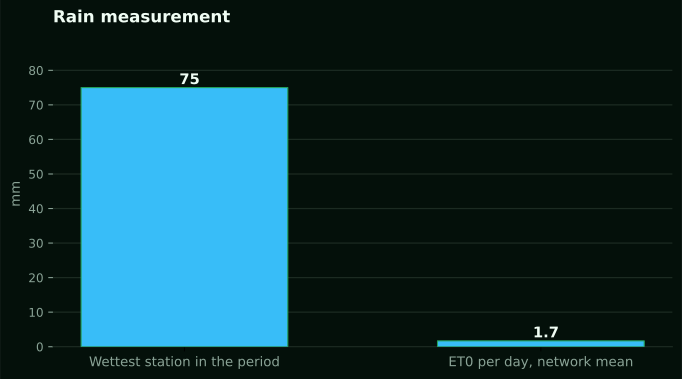
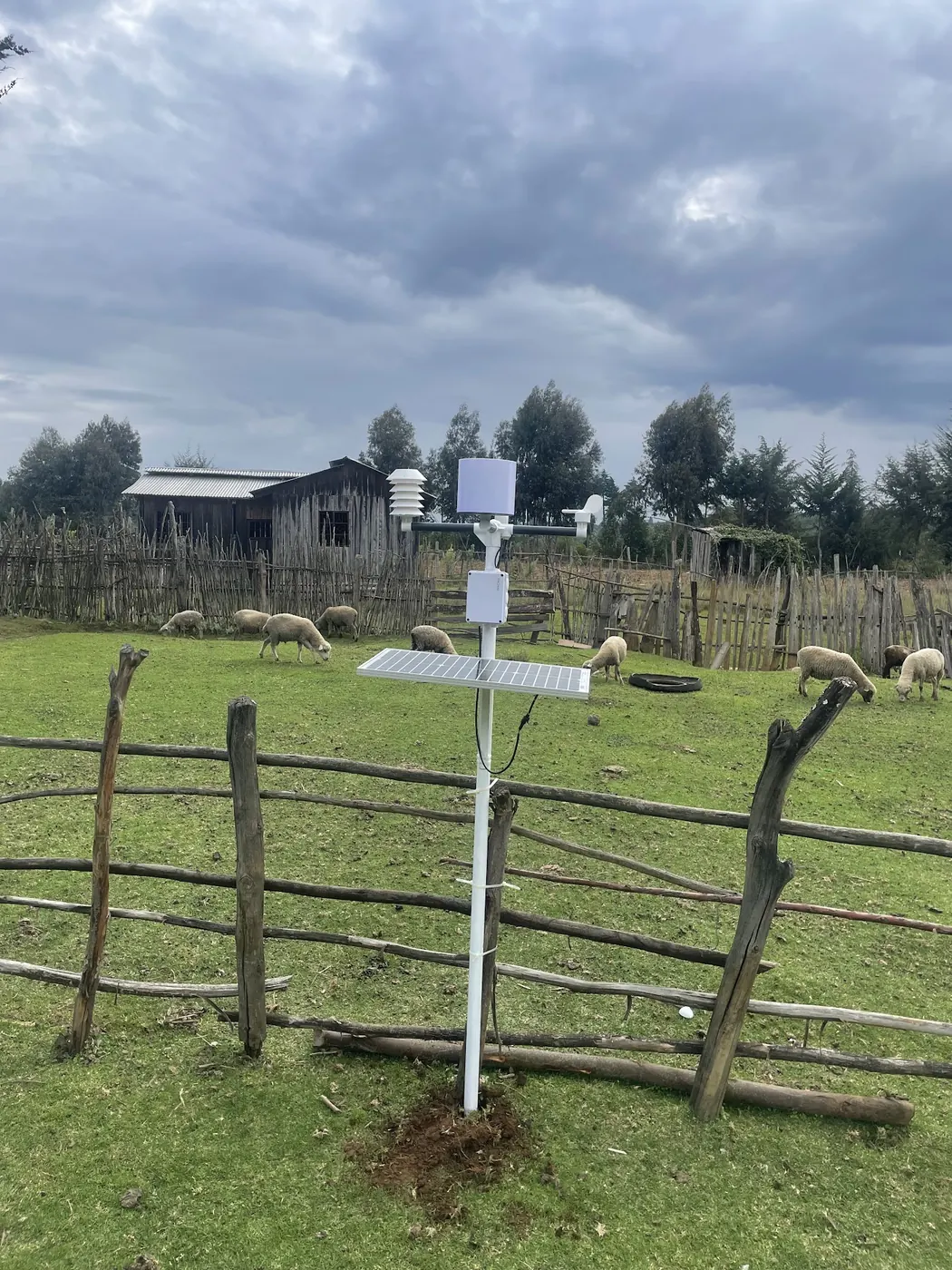
Our own gauges show why one fixed trip point tells only a thin story. Ten NuaSense weather stations in Kenya ran from 18 September to 18 October 2026, and station totals for the period went from 0.0 millimetres to 75.3 millimetres. That is a spread between stations that are not near each other, not a regional figure. It cannot be used to say what fell anywhere in particular. What it does show is that one site recorded nothing while another recorded enough to trip a half-inch sensor several times over, and a yes/no device at the wetter site would have reported the same thing after every storm above its threshold. Across the same network only 197 of 12,238 ten-minute readings carried any rain at all, 1.6 percent of the record. Rain on these sites came in short events separated by long dry stretches. The decision after each event depends on how much it brought, not on the fact that it came.
A longer record at the grid cells where our stations stand makes the same point over decades. CHIRPS is a satellite-and-gauge product, not one of our gauges. At those cells it puts long-term October rainfall at an average of 61 millimetres over 43 years from 1983 to 2025. The driest October was 20 millimetres in 1996, and the wettest was 290 millimetres in 2019. An October with 20 millimetres and one with 290 are different seasons for anything in the ground. A switch set at 12.7 millimetres cannot tell them apart beyond the first storm, and the first storm is rarely the one that matters. If you do fit a sensor, treat its threshold as something you chose for your block after watching a gauge for a season. Never treat it as a setting the factory got right.
Wind, height, and the error a switch never shows
A gauge has a failure the switch never reveals, because the switch never claims a quantity. Wind carries drops past the funnel, and the higher the funnel sits in the airflow, the more it loses. In the PMC review a Polish comparison looked at a Hellman totaliser mounted 1.0 metre above the ground and a GGI 3000 evaporimeter at 0.05 metres, with collector areas from 200 to 3000 square centimetres. Yearly collected precipitation differed by 3 to 4 percent, attributed to wind. Two sound catching instruments at the same place, and the variable that explains the gap is how exposed each opening was.
WMO takes this seriously enough to have put its reference in a hole. In 2010 it designated its first Measurement Lead Centre on Precipitation Intensity in Italy, and the reference system sits in a pit at Vigna di Valle near Rome. That puts the gauge opening at ground level, where wind cannot reach over it. Nobody is going to dig a pit on a vegetable block. But the direction of the error is the same here as in Italy or Poland: a gauge on a tall mast in open wind reads low, and a gauge tucked against a store wall reads whatever the wall's eddies deliver. Florida's siting rule is the minimum: keep it away from trees, the house and the irrigation system, and empty it after each rain. Our piece on how much clear ground each weather sensor needs works through exposure and mast height for a whole station. The rain gauge is the sensor height punishes most.
Non-catching sensors inherit the problem without the correction. The review notes that site conditions are rarely accounted for in their data, and no adjustments are usually applied for wind-induced bias. A millimetre figure is only as good as where the funnel stood. Our rain gauge page sets out how our stations record rainfall. The same siting rule applies to them as to a tin on a stick.
Three decisions that need the millimetre
Re-sowing comes first. A PlantVillage account of precision agriculture on feature phones records that in the 2019 long rains, cyclones Idai on 14 March and Kenneth on 25 April pulled moisture out of the atmosphere above Kenya and Uganda. Rainfall fell short, and many maize farmers had no germination and had to re-sow. Those growers were not asking whether it had rained. Showers came. They were asking whether enough had fallen to carry a seed through emergence. That is a quantity question, and a yes/no instrument offers nothing on it.
Second is the water budget on an irrigated block. Our stations compute reference evapotranspiration hourly with the FAO-56 method. Across nine stations over 18 September to 18 October 2026 it averaged 1.7 millimetres a day. That is reference demand from a well-watered grass surface, not crop water use. But the arithmetic a manager does with it is subtraction: millimetres that fell against millimetres the air took back. A rain sensor at half an inch can only report that a day's rain exceeded 12.7 millimetres. Whether that covered a week of demand at 1.7 a day, 11.9 millimetres over seven days, which it would, or a fortnight, 23.8 millimetres, which it would not, needs the figure the sensor does not have.
Third is the spray programme. A storm after an application raises the question of whether the product has been washed off and the pass needs repeating. None of the sources here gives a wash-off threshold in millimetres for any product, so this article does not either. That number lives on the label. The mechanism makes one thing clear: the answer is a quantity. A wet/dry switch tells the sprayer operator nothing the window did not already show him. A gauge gives him a number for the label. Our weather station page describes the spray window score the station derives alongside rainfall. Over the same period, 55 percent of station-hours scored below 30 on that index and 19 percent scored 60 or better. That is a reminder the spray decision depends on more than rain that has already fallen. Leaf wetness was recorded for 24 percent of station-hours, about 5.8 hours in an average day, and that figure too comes from a station, not from a switch.
Where yes or no is enough, and why it is usually the soil saying it
Some decisions are binary, and the switch is the right tool for those. The clearest is a timed irrigation cycle on a controller: run tonight or skip tonight. A grower with drip on a solenoid and a timer gains nothing by knowing that 14 millimetres fell rather than 12, because the controller's only options are on and off. The catch is how few blocks that describes. An AICCRA report on tech-backed irrigation in eastern and central Africa notes that less than five percent of cultivated land in sub-Saharan Africa is irrigated, against a global average of thirty percent, and automatic controllers are a fraction of that fraction.
Where the question is when to irrigate and when to stop, the same report shows the instrument answering it is not a rain device at all. Virtual Irrigation Academy was introduced in Africa in 2016 as a CSIRO and ACIAR partnership, with ASARECA coordinating a first phase from 2015 to 2019 in Malawi and Tanzania. It hands farmers colour-coded soil moisture sensors that show blue when soil is too wet, green when moisture is enough and red when too dry, plus a FullStop wetting front detector that shows when water has moved deep enough and irrigation should stop. No millimetres anywhere. By 2024 over 87,000 of these had gone to partners in more than 24 countries. One farmer trained at the Mubuku Irrigation Scheme in Kasese District, Uganda, in October 2024 saved 20,000 Ugandan shillings a week, about USD 5.5, and halved the time spent irrigating.
A yes/no instrument wins here, but it wins at the soil, downstream of rain and irrigation together. A rain sensor says the sky was wet. A soil colour says whether the root zone is. NuaSense's own overview of smart irrigation in Kenya covers drip kits, soil moisture probes and solar pumping as the pieces that sit between those two readings.
The rainfall number already on your phone
Many growers already receive a rainfall figure by SMS. iShamba, with over 500,000 users in Kenya according to the PlantVillage account, sends CHIRPS-based precipitation at 5 kilometre resolution as three numbers: rain in similar past short-rain seasons, rain so far this season and expected rain for the next ten days. That third number is a forecast, and this site does not deal in forecasts. The other two describe a grid cell 5 kilometres across, located to within a few kilometres by ward and nearest primary school. It is a regional story, not your field.
You measure how far a gridded product drifts from a gauge where there is a dense network to check against. An evaluation of the MRMS radar product in Harris County, Texas compared a product available at 1 kilometre and 2 minute resolution against 142 rain gauges across four floods in 2015, 2016, 2017 and 2019. At 15 minute and 15 kilometre resolution, the score was an R² of 0.78, an RMSE of 1.21 millimetres and a false alarm ratio of 0.34. It also tended to underestimate heavy rates and overestimate light ones. Making the time step coarser, from 5 minutes to an hour, improved the fit, and so did widening the spatial scale from 1 to 30 kilometres. None of that transfers to Kenya as a number; MRMS covers the continental United States. What does transfer is the shape: gridded rainfall works best for the season and the region, worst for the storm and the field. The PMC review says outright that such products rely on in-situ gauges for calibration, and that ground measurement remains indispensable.
Side by side
Laid out row by row for a phone screen, sensor first and gauge second, the two devices answer different questions on almost every line.
- Output: sensor gives wet or dry at a set threshold; gauge gives millimetres, in steps down to one-hundredth of an inch on the better instruments.
- Where it lives: sensor is wired to an automatic irrigation controller; gauge stands alone on a post or a station mast.
- Decision it fits: sensor, run or skip a timed cycle; gauge, re-sow or wait, repeat a spray or not, rain against ET0, this month against the record.
- What you check it against: sensor, three to five tins at the half-inch mark; gauge, a second plain cylinder beside it.
- Error it hides: sensor, everything about amount; gauge, wind loss at height, 3 to 4 percent a year in the Polish comparison.
- Needs a controller: sensor yes, gauge no. Needs a record keeper: sensor no, gauge yes.
- Threshold: sensor set by the owner, half an inch in the Florida and Derby rules; gauge has none, the grower applies one afterwards.
On an automated block, fit the sensor and keep a gauge too, because you will need to check the threshold and the irrigation decision will eventually need a budget. On a rain-fed or hand-valved block, a sensor has nothing to switch, so the gauge is the only one that earns its place. If the real question is the root zone, buy neither first; read the soil. The mechanism makes the opinion easy to hold: a switch cannot be made to measure, and a gauge cannot be made to close a valve.
What each costs, and when the right purchase is a tin
No source gives a purchase price for a rain sensor or a rain gauge, so this article gives none either. Florida's page calls the sensor low-cost, and it calls the weighing gauge dearer and more demanding than a tipping bucket. That ordering is the most that can be said without inventing a shilling figure. A plain manual cylinder, read after each storm and noted in a notebook, sits at the bottom of the ladder. It produces a millimetre record that answers the re-sowing and spray questions above. For a rain-fed smallholder on a small block, that is the right purchase.
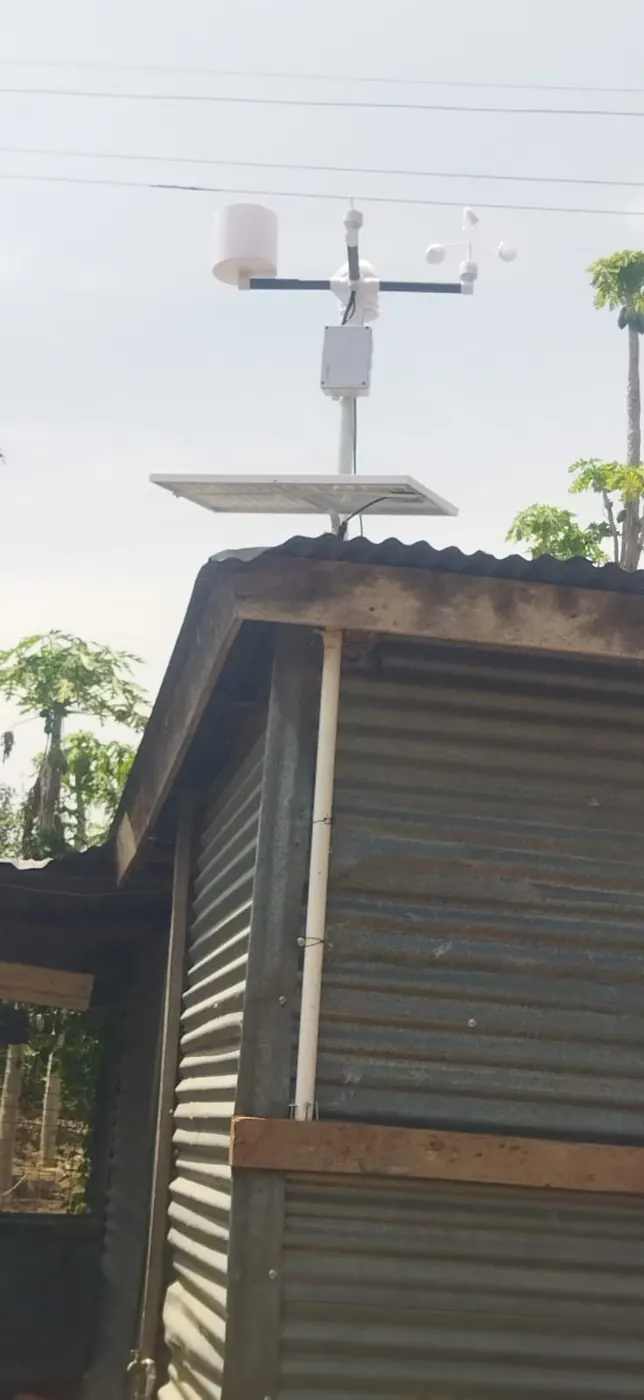
When the gauge has to log by itself, maybe because no one is on site at dawn or because the rainfall figure must sit beside evapotranspiration and leaf wetness for a spray call, you move up to a station. A NuaSense weather station costs KES 30,000 excluding taxes. It records rain with a tipping bucket calibrated to a per-tip volume set at installation, and reports about every ten minutes, together with temperature, humidity, pressure, sunlight and wind. Power comes from solar. It connects over a Safaricom SIM, with a data fee passed on at cost of about one US dollar a month, or over Wi-Fi at no cost, and the dashboard is free. Who should not buy it? A grower whose only question is whether last night's storm was big enough to skip the morning watering. A cylinder on a post answers that. Also a grower on a controller who wants a shut-off, since the station does not close a valve. Our post on what a farm weather station costs in Kenya itemises the running costs over a season. Payment falls due a month after the station is transmitting, with a money-back guarantee in the first three months. That is long enough to find out whether a millimetre figure changes any decision you make. If it does not, the right spend was the cylinder.