Measured by NuaSense weather stations and soil probes on Kenyan farms, over the period stated with each figure. Past readings, not a forecast.
One tip of rain on a cloudless afternoon
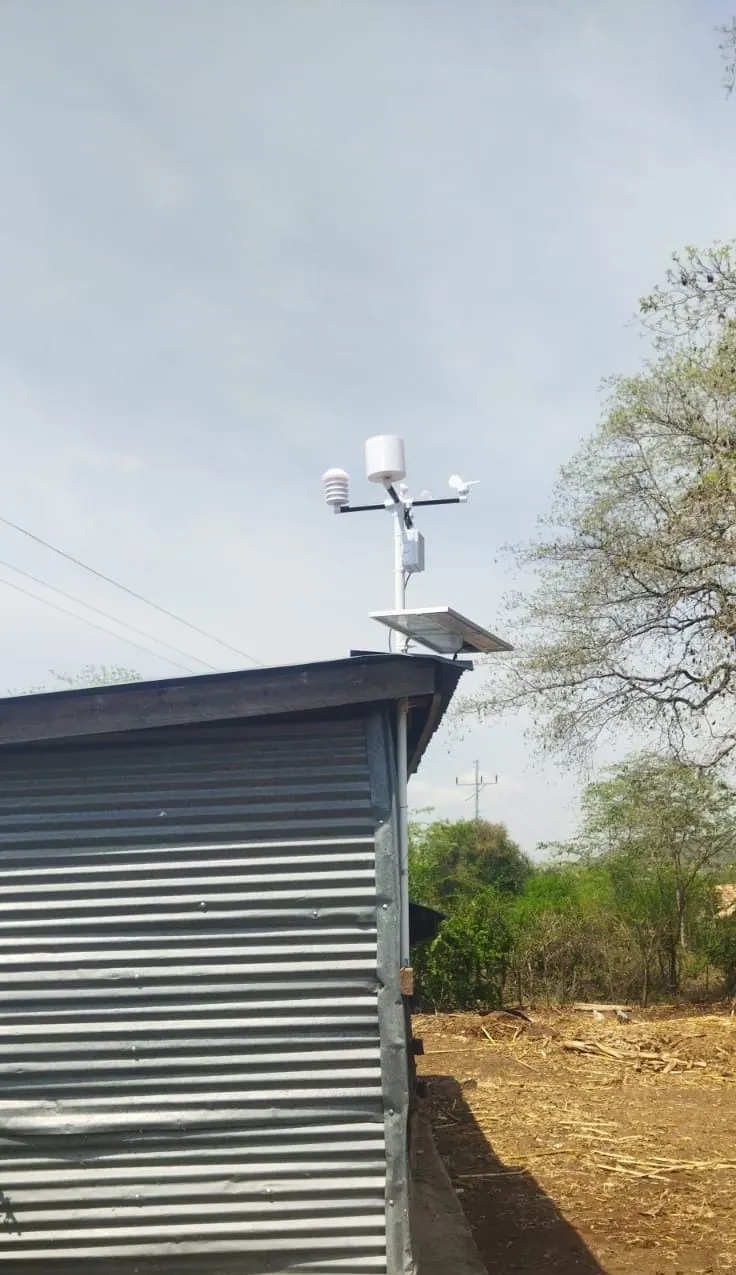
Maintenance begins with a reading you know is wrong. At three in the afternoon under a clear sky, the phone shows one tip of rain. Nobody on the block saw a drop. The ten-minute record on both sides is dry, humidity is well below saturation, and the wind column shows a gust passing through at that same moment. That one tip carries the argument here: the grower who sees it has four answers to choose from, and only one of them costs real money.
Answer one: ignore it. Answer two: climb the mast with a cloth, a spanner and a spirit level, and give it an hour. Answer three: call the vendor for a calibration or a new reed switch. Answer four: decide the station is old and buy another. Most people lean to one or four. One is lazy. Four is expensive. The case below argues for the second: the parts that fail on a farm station are the ones that get dirty, work loose or get lived in, and cleaning plus a spanner fixes all three.
There is a catch, though. A station that reports something, anything, is easy to trust. The FAO annex on measuring and assessing the integrity of weather data gives the warning in six words: no data are better than bad data. That leaves the monthly routine with two jobs. Keep the sensors clean. Learn the readings that tell you a sensor is going before it has gone.
Four ways to answer it, side by side
Before you touch anything, lay out the four answers. Read them as a table: what each option costs, what it buys, and when it is the honest call.
- Do nothing. Costs nothing today. Buys a record you cannot defend when the irrigation total built on it looks wrong later. Right call only when the reading has not arrived at all: a station with no signal produces a gap, and a gap is not a fault.
- Clean and check. Costs a cloth, an alcohol wipe, a spanner, a level and about an hour a month. Buys a clear funnel, a bucket that tips on rain and only rain, a shield with nothing nesting in it and a panel that charges. Right call for almost every fault that shows up as odd rain, odd humidity or a battery that fades through the night.
- Calibrate or replace one part. Costs a vendor conversation plus the part, and CGIAR's paper on the ADT weather station data tool names high maintenance requirements and replacement parts that may not be available locally as a well-known weakness of automatic stations. Right call when cleaning did not fix it.
- Buy new. Costs KES 30,000 excluding taxes for a NuaSense weather station, or less if you build an open-source unit yourself. Buys a station, and nothing else. Wrong call if the old one only needed the hour with the cloth.
Put plainly, the second option is what this article is about. The third and fourth return at the end, with prices and a straight statement of who should not spend the money.
The funnel and the tipping bucket
Start at the top of the rain gauge. Most false readings are born there. The Cornell NEWA weather station maintenance guide lists what clogs the tipping bucket screen: leaves, moss, algae, pollen and general debris. It says to clean the bucket at least one to two times a year, and more often depending on what surrounds the station. Orchards, vineyards and woods are named as the worst neighbours. That guidance was written for stations in New York. On a Kenyan block the neighbours differ, but the logic carries straight over. A mast beside a mango line, a napier hedge or a eucalyptus windbreak collects more than one standing in open pasture. A station near a dusty access road collects a film of fines that a northern orchard never sees. Look into the funnel every month. Clean it when it needs it, not on a calendar.
Follow the NEWA procedure for the bucket step by step. Switch the station off. Loosen the four screws that hold the bucket to the gauge base, then twist it counter-clockwise to remove it. Straighten the cotter pin legs, pull the pin, lift out the screen and clear the drain hole. When you refit it, bend the cotter pin legs upward so they cannot touch the tipper, then switch the station on. If the gauge still misbehaves after that, NEWA says the reed switch may be bad. That is a vendor call, not a cloth job. Do not skip the cotter pin detail. A pin leg resting against the tipper makes a bucket stick or double-count, and you will have created a fault while curing one.
Level comes next. The University of Florida extension note on farm weather station installation and maintenance reduces rain gauge upkeep to two things: a clean collection funnel and a level gauge. It says to check level with a carpenter's level laid across the opening. A tilted bucket tips early on one side and late on the other. The gauge counts tips and converts them at the per-tip volume it is calibrated to, so a tilt becomes a rain error for every storm that follows. It stays invisible in the record because the count still looks plausible. Our rain gauge page explains how a count becomes millimetres. Level and cloth together take minutes, and between them they cover the two rain faults a grower is most likely to meet.
Mast fixings: the bolt that makes rain out of wind
Let's go back to that afternoon tip. NEWA names the mechanism: if the station is mounted badly, a strong wind can jostle it enough to swing the tipping bucket arm, and it records a small amount of rain in dry weather. The bucket did its job. The mast moved under it. So a dry-weather tip points to the mast before it points to the gauge, and that is why the spanner belongs in the monthly kit next to the cloth.
NEWA's own interval says to check cables, mounting brackets, poles and posts at least once a year for stability, verticality and secure fastening. That is a northern interval, written for a station that sits under snow and out of reach for part of the year. A Kenyan mast can be reached all year, and it carries different loads: afternoon gusts that come in with convective storms, livestock leaning on anything upright, a guy rope that a child or a goat has found. No Kenyan interval has been published, so set your own. Monthly is cheap. Push the mast at head height and watch the base. After rain, check whether the guy anchors have lifted in soft soil. Hold a level against the pole.
That same loose bolt costs you more than rain. NEWA notes that jostling affects radio transmission as well as the bucket, and on a NuaSense station the mast carries two radios: the one that sends the weather reading to the internet, and the LoRaWAN link that brings the soil probes online. When the mast sways, the antenna's view of the field changes, and you can lose a probe reading at the same moment the station invents a tip. The clear-ground rules for each sensor, and the ten-times-the-obstacle rule for siting, were worked through in our post on weather station siting. The monthly check is just confirming that the mast still stands where that post told you to put it, and still stands straight.
The radiation shield, and why you must not seal it
The white louvred stack on the mast is the shield, and the temperature and humidity sensor sits inside it. The Arizona guide on siting and maintenance of weather stations puts it plainly: a combined temperature and relative humidity sensor housed within a radiation shield to protect it from direct sunlight. FAO adds that these shields are naturally ventilated, and are sometimes artificially aspirated with a small fan to reduce the bias that solar heating puts on the reading. As far as air temperature goes, the shield is the instrument. A dirty one reads warm.
The failure that generic guides miss is a tenant. NEWA says spiders and insects nest inside the support pole and inside the radiation shield. Anyone who has left a pipe standing in a Kenyan field for a season knows which insects take the invitation. A nest in the louvres blocks airflow, and blocked airflow turns a shield into an oven on a clear afternoon. The sensor then reports the inside of a box, not the air over the crop.
NEWA's fix has two halves, and the second half is the one to remember. Holes in the pole and the housing should be covered with duct tape or silicone sealer. The Temp/RH shield itself must not be sealed. The temptation is obvious: you have just evicted a wasp, the silicone is in your hand, and the louvres look like the way it got in. Seal them and you have removed the ventilation the sensor needs, and every temperature from then on carries a warm bias, every humidity a dry one. Clear the nest, leave the louvres open, tape the pole.
Wipe the louvres on the same visit. Dust is not a nest, but a grey shield absorbs more sun than a white one, and over a dry month the film builds without anyone noticing. A damp cloth is enough. Nothing in this section needs a purchase, and nothing in it should be skipped, because temperature and humidity feed every derived value the station produces, from dew point to the spray window score.
Solar panel and light sensor: a wipe, not a part
Two glass surfaces face the sky, and both lose their value to dirt. The first is the solar panel that keeps the battery charged. NEWA's instruction is to clean it with an alcohol wipe, or a soft clean damp cloth if there is no wipe, and the guide singles out one moment for extra attention: after spraying near the weather station. Spray drift lands on the panel as a film that water alone does not shift. Our safe spraying guide on the NuaSense blog covers product choice and the timing of a spray; the station maintenance corollary is that the day after a spray is the day to wipe the panel.
The sunlight sensor's glass diffuser is the second surface. NEWA advises cleaning it with a damp cloth and replacing it once it yellows, which usually happens after several years of service. Yellowing isn't dirt. The glass is ageing under the sun, and no cloth will undo that. This is one of the few real part purchases in this article, and it comes years in, not months. FAO's annex adds that the cheaper silicon diode pyranometers aren't sensitive to the full visible spectrum, so their calibration holds only for upward-facing solar measurement. A yellowing dome narrows that further.
The readings that show a sensor is going
Cleaning takes care of the faults you can see. Drift is the one you can't, and the skill worth having is reading the record for its signature before the sensor dies outright. NEWA gives the clearest example: low relative humidity readings on dewy mornings or in rainy weather point to a sensor malfunction. That test costs nothing. Walk out at dawn, feel the grass, open the phone. If the lawn is soaked and the humidity column says dry air, the sensor is wrong and cleaning won't fix it. For scale, across 17 NuaSense stations in Kenya from 09 October to 08 November 2026, relative humidity ranged from 19 to 100 percent with a mean of 72. A healthy sensor hits the top of that range on a wet morning. One that never does any more has drifted.
Rain has its own signature. Over the same period, 737 of 26,994 ten-minute readings carried any rain at all, or 2.7 percent. If a station's dry-day readings show scattered single tips at the time of each gust, it is counting wind, as the mast section explained. If its wet days show nothing while a neighbour's bucket is filling, the funnel is blocked or the switch is dead. NEWA puts the general method at farm scale: compare temperature and humidity against a calibrated thermometer or a nearby station.
Sunlight drifts downward. NEWA records that out-of-range solar radiation can keep a station out of the selection list for its apple thinning model: the model won't use a station it can't trust. The same logic holds for reference evapotranspiration computed from a station, which a NuaSense station does hourly with the FAO-56 method. When the midday reading under a clear sky sits lower month after month, the dome is telling you something before the ET0 column does.
Then there is the signature of absence. CGIAR's ADT tool, running in Ethiopia, Ghana, Kenya, Rwanda and Zambia, exists to show in real time which stations are working and which are offline. Networks built from different donors' hardware produce fragmented, unharmonised data, and nobody can tell a quiet day from a dead sensor. A single farm needs the same habit at smaller scale. Before you act on an irrigation total or a spray window score, check that the station actually reported through the period the number covers. A total built over a gap is a total with a hole in it, and the dashboard won't always say so. Wind belongs in the same scan: a steady high reading in calm air is a counting problem, while a single gust in an otherwise calm record is a peak within the reporting interval and more likely a real squall. What each sensor can honestly carry is set out in the earlier post on farm weather station accuracy.
When a drifting sensor should come off the dashboard
Here FAO's six-word rule becomes a maintenance decision, not a slogan. The annex says estimates of reference evapotranspiration are no better than the weather data they are built on, and that data integrity should be assessed before any of it goes into an ETo equation. It goes further: biased, faulty or nonrepresentative local weather data can cause more economic and hydrologic harm than using reasonable estimates or textbook crop coefficients. Put another way, a bad humidity sensor on your own mast can be worse for the irrigation schedule than having no station at all.
FAO also gives the counterweight, and it matters for a grower who might otherwise pull every sensor at the first odd reading. The annex pairs the caution with its corollary, that no data should be trusted until validated, and says the right position is somewhere between the two. For a Kenyan farm, the practical reading is a triage rule. A sensor that has failed the dawn test, or that shows dry-weather tips you have traced to a loose mast, should be kept out of the derived values until it is fixed. Across 15 NuaSense stations in the same October to November period, computed ET0 averaged 1.5 mm per day; a drifting humidity or sunlight sensor shifts a figure that small by enough to matter over a season of scheduling. Taking the channel out for a month costs you a gap. Leaving it in costs you water applied against a number that was never real.
Distance decides the fallback. The Arizona Cooperative Extension grower's guide to selecting and using weather stations cites WMO guidance that data are most reliable within roughly 60 miles for large-scale weather patterns but only within about 6 miles for local applications such as precision farming. Arizona's network has 32 well-maintained stations in its farming areas. A Kenyan grower usually has no such dense public network to fall back on. That is the strongest argument for keeping the on-farm station honest: when its sensor drifts, the nearest trustworthy reading may be well outside the local radius, and that is the moment to know it.
Buying new, and who should not
The fourth option needs its own figures. The maintenance case only works if you put a price on the other choice. At the low end are the IWMI low-cost mobile weather stations. They are put together locally from off-the-shelf parts and open-source software on Arduino boards. They measure rainfall, temperature and wind every five minutes, run on solar, log to a microSD card and send SMS alerts. IWMI quotes $350 each and a claimed life of up to ten years. That is IWMI's own figure for its own build in a flood-resilience context. It is not a Kenyan retail price. It does show the market floor for a grower or agrovet with a soldering iron and patience.
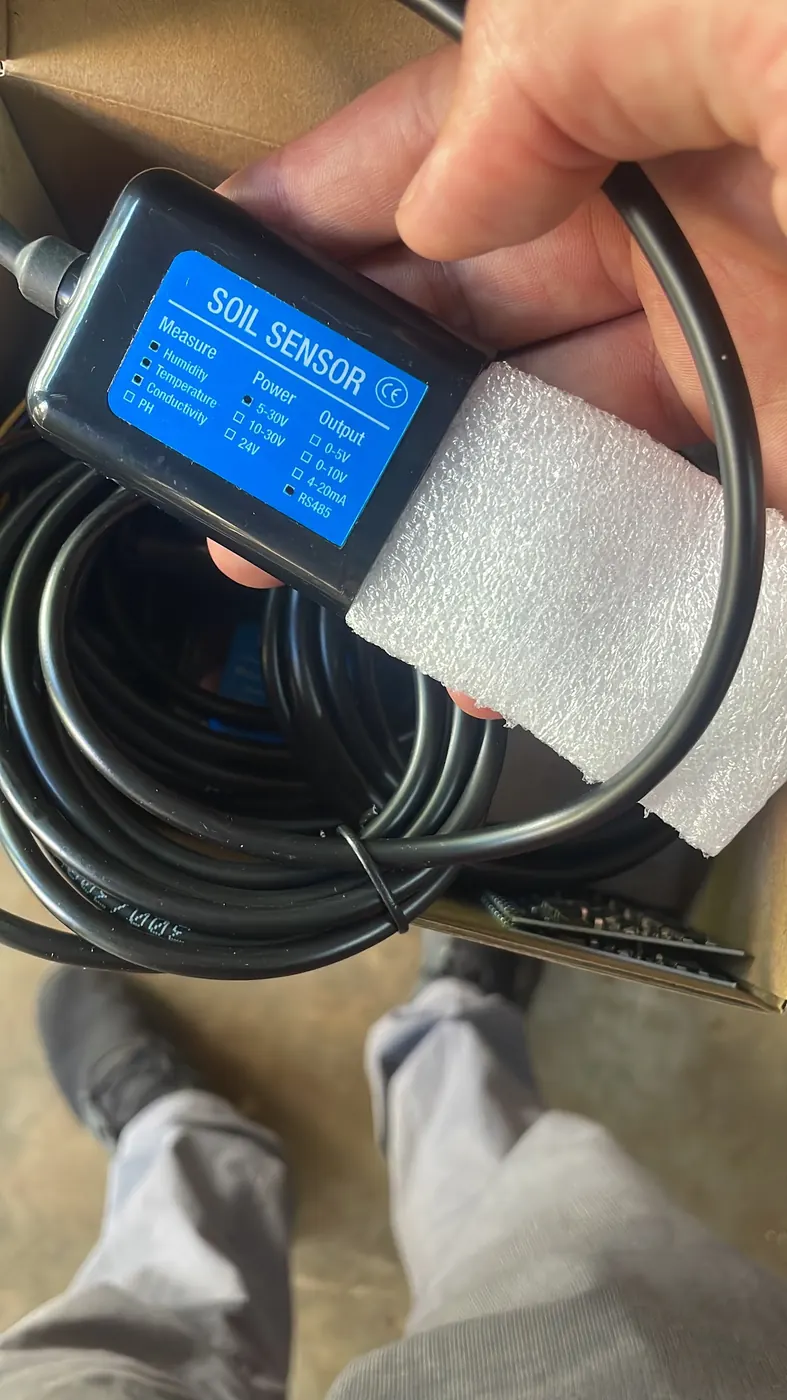
At the other end, a NuaSense weather station costs KES 30,000 excluding taxes. It reports air temperature, humidity, pressure, sunlight, rainfall in millimetres, wind speed, gusts and direction about every ten minutes. It runs on solar. It gets online through a Safaricom SIM passed on at cost of about one US dollar a month, or over the farm's Wi-Fi for nothing. It also carries readings from any soil sensors on the farm, which cost KES 7,000 each. The warranty is six months, with a full refund within three months.
Here is the plain version. Skip a station if the one on your mast only needs the hour described above. Skip it if the only number you act on is a monthly rain total. A manual gauge read every morning gives you that. Skip it if nobody on the farm will do the monthly walk. An unmaintained station drifts into exactly the bad data FAO warns against, and you will have paid to be misled. Buy one when you act on hourly values, spray windows, leaf wetness or ET0, and when you will keep it clean.
The hour, in the order you walk it
All of the above comes down to one visit a month, walked from the ground up. No published Kenyan schedule exists for a farm station. The intervals in NEWA and the Florida note are northern and assume winter puts the station out of reach. The cadence below is a working default, not a standard. Shorten it where the station stands beside a sprayed block, a dusty road or a tree line.
- Push the mast at head height and watch the base; check guy anchors for lift and put a level against the pole. Tighten anything that moves.
- Look down the funnel. Clear leaves, dust and insects. Lay a level across the opening and correct the tilt.
- Lift the bucket on NEWA's procedure if the screen or drain hole is fouled, and bend the cotter pin legs clear of the tipper on reassembly.
- Inspect the radiation shield for nests and dust. Clear and wipe. Tape holes in the pole. Leave the louvres open.
- Wipe the solar panel with an alcohol wipe, and again the day after any spray nearby. Wipe the sunlight sensor's glass and note any yellowing.
- Spin the cups so they coast freely, check the vane against due north with the phone's compass, and recheck both if the mast was touched.
- Open the phone at dawn. If the grass is wet and humidity reads dry, flag the sensor. Scan the dry days for lone tips.
Ask the vendor how often calibration is due. NEWA's planning figure is about every two years, and it is a planning figure, not a rule. If a channel fails the dawn test twice, take it out of the derived values until it is fixed. That habit keeps a farm station worth the mast it stands on, more than any part you could buy.